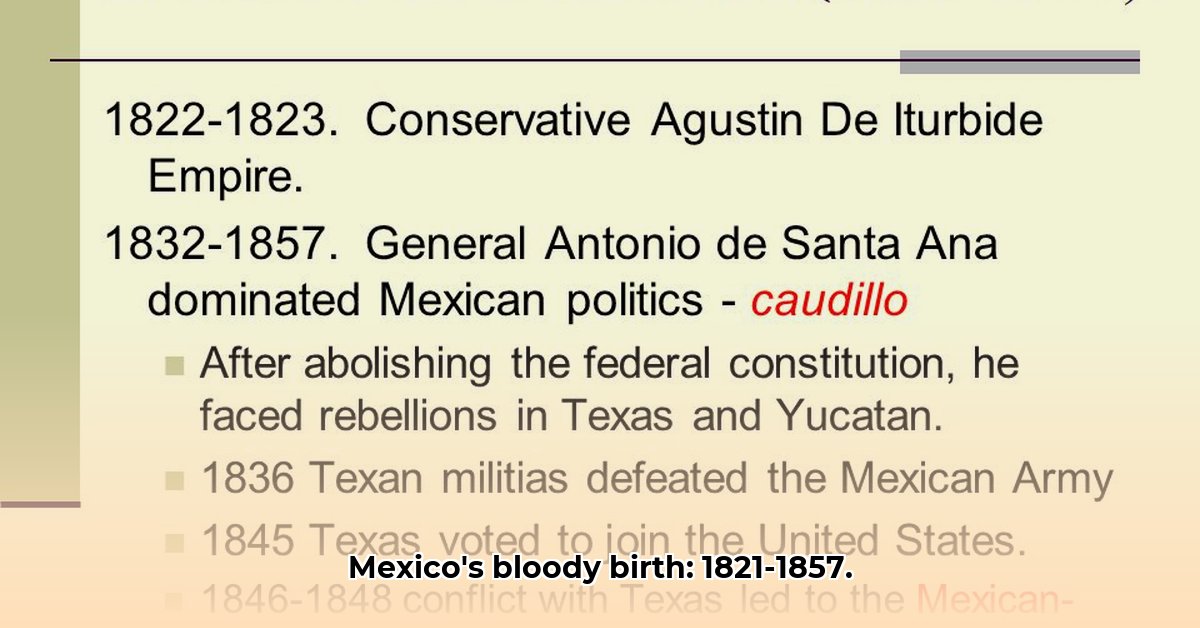
Mexico's journey to nationhood between 1821 and 1857 was a tumultuous period marked by significant territorial shifts. Imagine a nation constantly redrawing its borders, a landscape sculpted not only by warfare but also by internal political struggles and external pressures. This article explores the key events, figures, and underlying forces that shaped Mexico's evolving territorial landscape during this volatile era. What were the primary drivers behind these dramatic changes? And how did these events indelibly shape the Mexico we know today? Let's uncover the answers. For a visual representation of these shifts, check out this historical map.
A Brand New Nation, A Messy Inheritance
Mexico's independence from Spain in 1821 brought immense territory—a vast expanse stretching from the present-day southwestern United States to Central America. This newly acquired freedom, however, came with a mountain of challenges. The immense size of the nation, coupled with deep regional divisions and a weak central government, created inherent instability. How could such a vast and diverse territory be effectively governed? This fundamental question played out in the conflicts that characterized the following decades.
The Great Tug-of-War: Centralists vs. Federalists
The early years of Mexican independence were dominated by a bitter ideological struggle between centralists and federalists. Centralists advocated for a strong, centralized government, believing it essential for maintaining order and controlling the nation's resources. Federalists, conversely, championed greater autonomy for individual states, arguing for a more decentralized system. This fundamental disagreement sparked repeated conflicts, with each side's victories dramatically reshaping the political map of Mexico. Each swing of the pendulum – from centralization to federalism and back again – had profound implications for Mexico's territorial borders.
Texas: A Story of Secession and Lost Territory
Texas exemplifies the tensions between the central government and its constituent regions. Initially joining the Mexican federation, Texas’ cultural differences and distinct political visions fostered growing tensions with the central government in Mexico City. This ultimately culminated in the Texan Revolution (1835-1836), resulting in Texas's independence and a significant loss of Mexican territory. This painful secession highlighted a critical failure of the Mexican government: its inability to effectively manage its diverse regions and address their growing grievances. The loss of Texas served as a stark warning about the fragility of the newly formed nation.
The Mexican-American War: A Catastrophic Loss of Territory
The Mexican-American War (1846-1848) proved to be a devastating blow. The war's outcome resulted in the loss of approximately half of Mexico's territory. California, Nevada, Utah, and significant parts of Arizona, New Mexico, Colorado, and Wyoming were ceded to the United States under the Treaty of Guadalupe Hidalgo. This territorial amputation left a deep scar on the nation's psyche and redefined its geographic boundaries, impacting its relationship with the United States for generations to come. Was there any possibility of a more favorable outcome for Mexico in the Mexican-American War? Historians continue to debate the strategic decisions and geopolitical factors that led to this catastrophic loss.
Rebellions and Instability: A Nation in Tumult
The challenges didn't end with the war. Internal conflicts, such as brief declarations of independence by regions like Yucatán and Sonora, further underscored the persistent instability. Mexico struggled to maintain its territorial integrity both internally and externally, facing a constant barrage of challenges to its territorial control.
The Reform War: Further Instability and Internal Strife
The Reform War (1857-1861), while primarily focused on political and religious reforms, further destabilized the nation and exacerbated existing territorial tensions. The war’s prolonged chaos hindered any sustained efforts to consolidate a strong national identity or fortify Mexico's borders. The conflict contributed to the continuing instability and deepened the country’s struggle for both political consolidation and well-defined territory.
A Visual Timeline of Territorial Evolution (1821-1857)
| Period | Key Events | Territorial Impact |
|---|---|---|
| 1821-1836 | Independence, early federalist experiments, Texas Revolution | Loss of Texas; growing internal divisions; weakened central authority. |
| 1836-1846 | Centralist rule, various rebellions | Continued instability; some regions briefly declaring independence. |
| 1846-1848 | Mexican-American War | Massive territorial losses to the United States; Treaty of Guadalupe Hidalgo. |
| 1848-1857 | Post-war instability, La Reforma | Continued internal conflicts and attempts to redefine national identity and borders; further territorial disputes. |
This timeline highlights the dynamic and unpredictable nature of Mexico's territorial evolution during this era. Each major event fundamentally reshaped the nation´s political and geographical map.
A Nation Defined by Conflict: Conclusion
The period from 1821 to 1857 was a crucial formative era for Mexico, fraught with intense internal and external conflicts. The nation's struggle to define and defend its borders profoundly shaped its national identity and left a legacy that continues to resonate in modern Mexico. Understanding this tumultuous period is essential for grasping the complexities of Mexico's history and its ongoing relationship with its neighbors. The continuous research into this pivotal era adds further layers of understanding, enriching our comprehension of this turbulent chapter in Mexican history.